
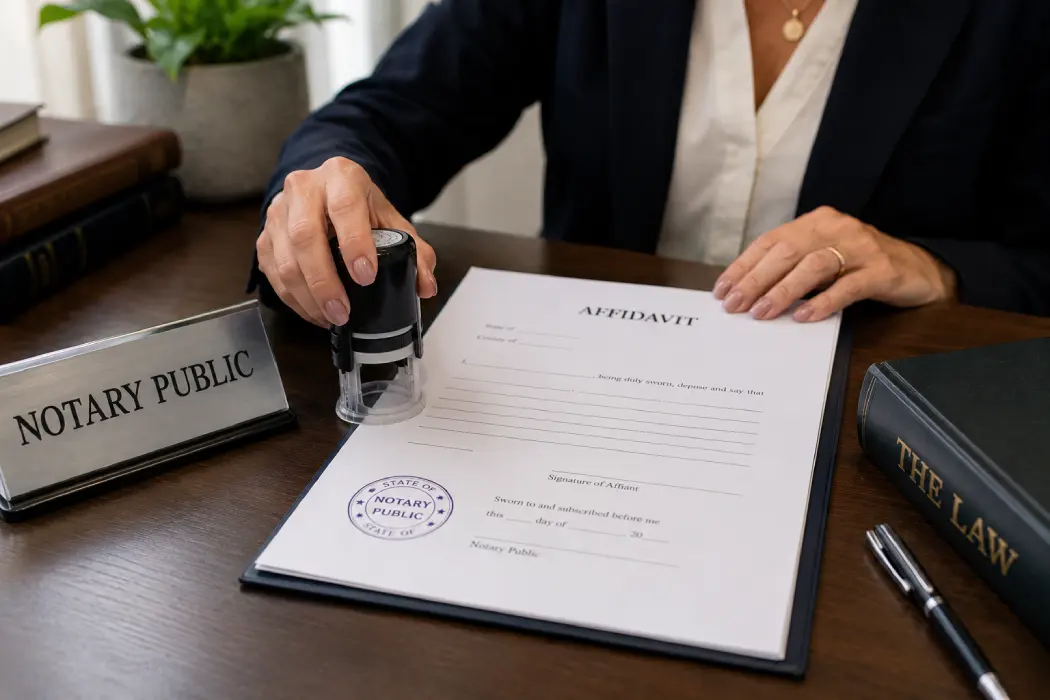
If you’ve been asked to provide an affidavit for a legal matter, a government agency, or a personal transaction, one of the first questions that comes up is whether it needs to be notarized. In the vast majority of cases, the answer is yes. An affidavit only carries legal weight because the person signing it is swearing, under penalty of perjury, that the statements inside are true, and a notary public’s job is to formally witness that oath. This guide walks through exactly why notarization matters for affidavits, what the process actually involves, and how to get one completed quickly.
What An Affidavit Actually Is
An affidavit is a written statement of fact that the signer swears to be true, typically for use in a legal, governmental, or business context. Because the statement is made under oath, courts, government agencies, and other institutions treat affidavits as a form of sworn testimony. This is precisely why notarization is so important. Without a notary confirming that the statement was signed knowingly, willingly, and by the person it claims to represent, an affidavit generally has no legal standing and cannot be relied upon by the party requesting it.
Why Notarization Is Required
The role of a notary public in this process is to serve as an impartial third party witness. When you sign an affidavit in front of a notary, they confirm several things: that you are who your identification says you are, that you understand the document you’re signing, and that you’re signing voluntarily rather than under duress. Once these elements are confirmed, the notary completes the notarial certificate and applies their official seal, which formally certifies that the process was carried out correctly under the law.
In Texas, this entire process is governed by the rules set forth through the Texas Secretary of State, which oversees notary commissioning, conduct standards, and the legal requirements around identification and signature witnessing.
What The Notary Checks During The Appointment
Valid government issued identification. Every signer must present valid photo identification before the notarization can take place. This is a non-negotiable legal requirement, not a formality that can be skipped.
Willingness and awareness. The notary must be reasonably confident that you understand the general nature of what you’re signing and that you’re doing so of your own free will, without pressure or coercion.
The signature itself, witnessed live. This is one of the most commonly misunderstood requirements. You cannot sign an affidavit ahead of time and simply bring it to a notary for a stamp. The notary is legally required to witness the act of signing. If you’ve already signed the document before your appointment, you’ll typically need to sign it again in front of the notary, sometimes on a fresh copy of the document.
Common Types Of Affidavits That Require Notarization
Affidavits come up in a wide range of personal and legal situations, and the notarization process is largely the same regardless of the specific type. Some of the most common examples include:
Affidavits of identity or name change, often needed when correcting records or updating legal documentation after a life change.
Small estate affidavits, used in certain probate situations to transfer a deceased person’s assets without a full probate proceeding.
Affidavits of heirship, commonly used in real estate and property matters to establish rightful ownership when a deceased person did not leave a will.
General sworn statements, used for a wide variety of legal, business, and personal purposes where a formal, witnessed declaration is required.
These fall under general notary work, available through Mobile Notary Services for straightforward appointments, or Additional Notary Services for less common document types that still require professional notarization.
What Happens If Your Affidavit Isn't Notarized
If you submit an affidavit that hasn’t been properly notarized, it’s very likely to be rejected by whatever court, agency, or institution requested it. This can cause delays in legal proceedings, probate matters, or business transactions, and in some cases may require starting the process over entirely. Because of this, it’s worth confirming notarization requirements early, rather than discovering the issue after submission.
How To Get Your Affidavit Notarized Quickly
Rather than tracking down a bank branch with notary hours or waiting in line at a UPS store, a mobile notary can come directly to your home or office anywhere throughout the Dallas Fort Worth Metroplex. This is particularly useful for time sensitive affidavits, such as those tied to a legal deadline or a closing that’s already in progress.
To prepare for your appointment, have your valid photo ID ready, bring the unsigned affidavit, and make sure any additional signers required by the document are present at the time of the appointment.